
Lee County Deed Types Explained
Real-estate recording in Lee County belongs to the Clerk of Superior Court. That role matters. The clerk is the recorder of deeds. It is not the administrative desk that handles general records requests. The office takes in warranty deeds, quitclaim deeds, security deeds, assignments, easements, rights-of-way, plats, fi fas, UCC filings, trade names, and property-transfer-tax documents. Every instrument type carries a distinct legal effect. Read the label on the deed before assuming what it did.
| Deed Type | What It Does | Common Use |
|---|---|---|
| Warranty deed | Transfers the stated interest with deed warranties | Many ordinary sales |
| Quitclaim deed | Conveys whatever interest the grantor may hold | Interest cleanup or family transfers |
| Security deed | Secures a debt against real property | Georgia mortgage lending |
| Executor or estate deed | Transfers through an authorized estate party | Probate-related transfers |
| Tax deed | Records a transfer from a tax-sale process | Delinquent-tax property |
A deed moves a stated interest in land. Not every filing does. A security deed or lien burdens the interest while the owner of record stays the same, and an easement grants someone a use right over part of the parcel. A plat maps a division, while the deed holds the conveyance language. When title, access, or boundary questions overlap, read Lee County deed records as a set rather than one filing at a time.
Lee County Deeds at the Clerk
Superior Court Clerk Sara Clark records Lee County deeds at 100 Leslie Highway in Leesburg. Mail reaches the office at P.O. Box 49, Leesburg, Georgia 31763, and the phone number is 229-759-6018. Go straight to the clerk when you need an image that is not online. The office also handles certified copies, older books, and help decoding an index citation.
For a web search, the statewide GSCCCA Real Estate Index pulls together county transmissions. It offers name, book-and-page, and property-oriented paths. Image availability and the depth of historical data vary by county. A blank result does not mean no deed exists. So follow up with the office before concluding anything.
The clerk's official page lists contact details and recording services.
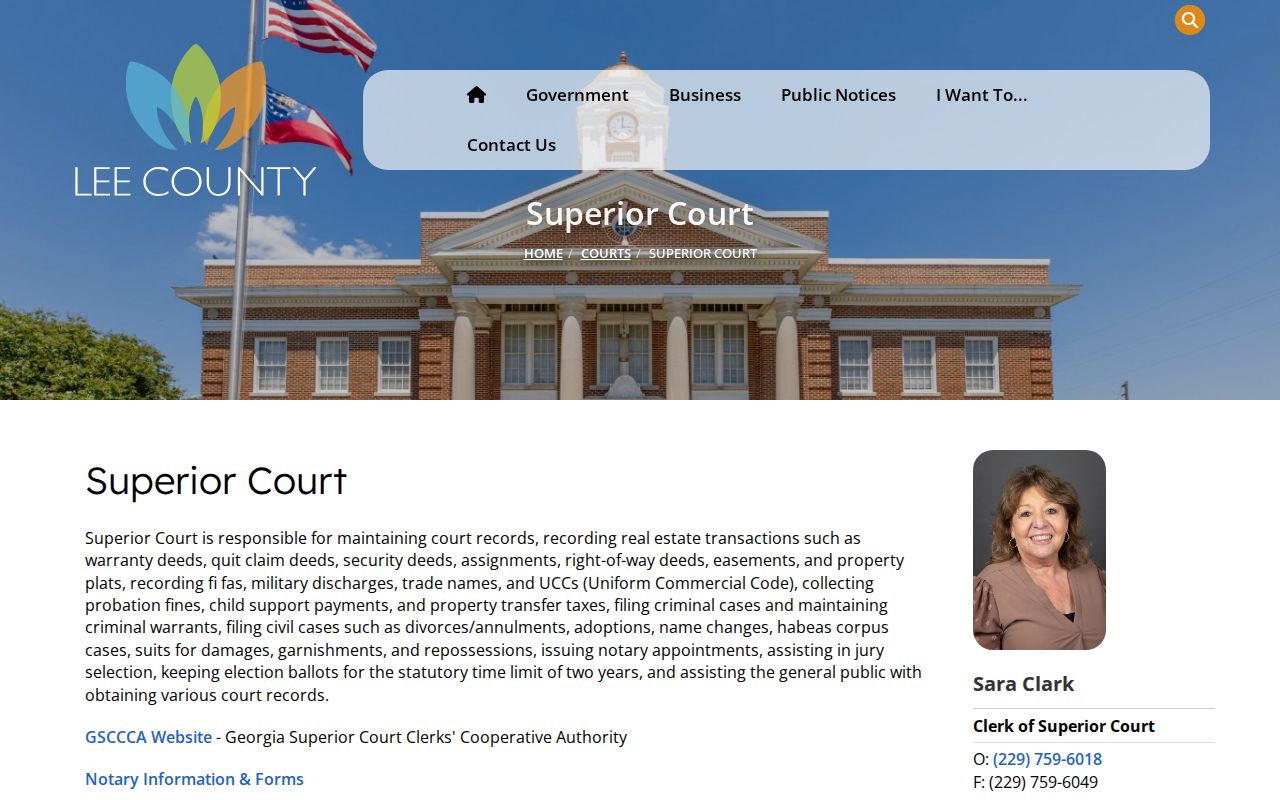
The office list confirms that the clerk holds deeds, plats, easements, liens, and related filings. It also marks the offline path whenever the portal comes up short.
Filter Lee County Deed Records
The GSCCCA name form splits people from businesses and filters by county, party role, instrument type, and date. Search narrowly when you know the transfer period. If nothing surfaces, widen the date range and try an exact legal-name variant: initials, a prior surname, a trust name, an estate styling, or a company name.
| Index field | Choice | Purpose |
|---|---|---|
| Party type | Individual or business | Sets the name inputs |
| Party role | Grantor or grantee | Separates transfers out and in |
| County | Lee | Limits statewide matches |
| Instrument | Recorded document class | Removes unrelated filings |
| Date range | Recording span | Targets a transaction period |
When another record already supplies the citation, the book-and-page search is the faster route. A separate property search adds subdivision-oriented controls where counties participate. Rely only on filters the live form actually offers.
Walk Lee County's Grantor-Grantee Chain
The grantor conveys the interest. The grantee receives it. Begin with the newest deed matching the parcel, then walk backward: for each grantor, find the deed by which that party acquired the same land. Check the legal description at every step. Names alone make a weak match, since Lee County records contain repeated names, initials, estates, trusts, and companies that muddy the trail.
- Find the newest likely owner as grantee and open the matching deed record.
- Save the grantor, grantee, deed type, date, book/page, capacity, and legal description.
- Search that grantor as an earlier grantee and match the same tract or parent tract.
- Repeat until the web trail ends, then request the cited deed book or archival source.
- Grantor
- The party transferring the stated interest.
- Grantee
- The party receiving the stated interest.
- Chain of title
- The linked sequence of conveyances for the same land.
- Book/page
- A volume-and-page reference to a recorded document.
The statewide party search is shown in this capture.
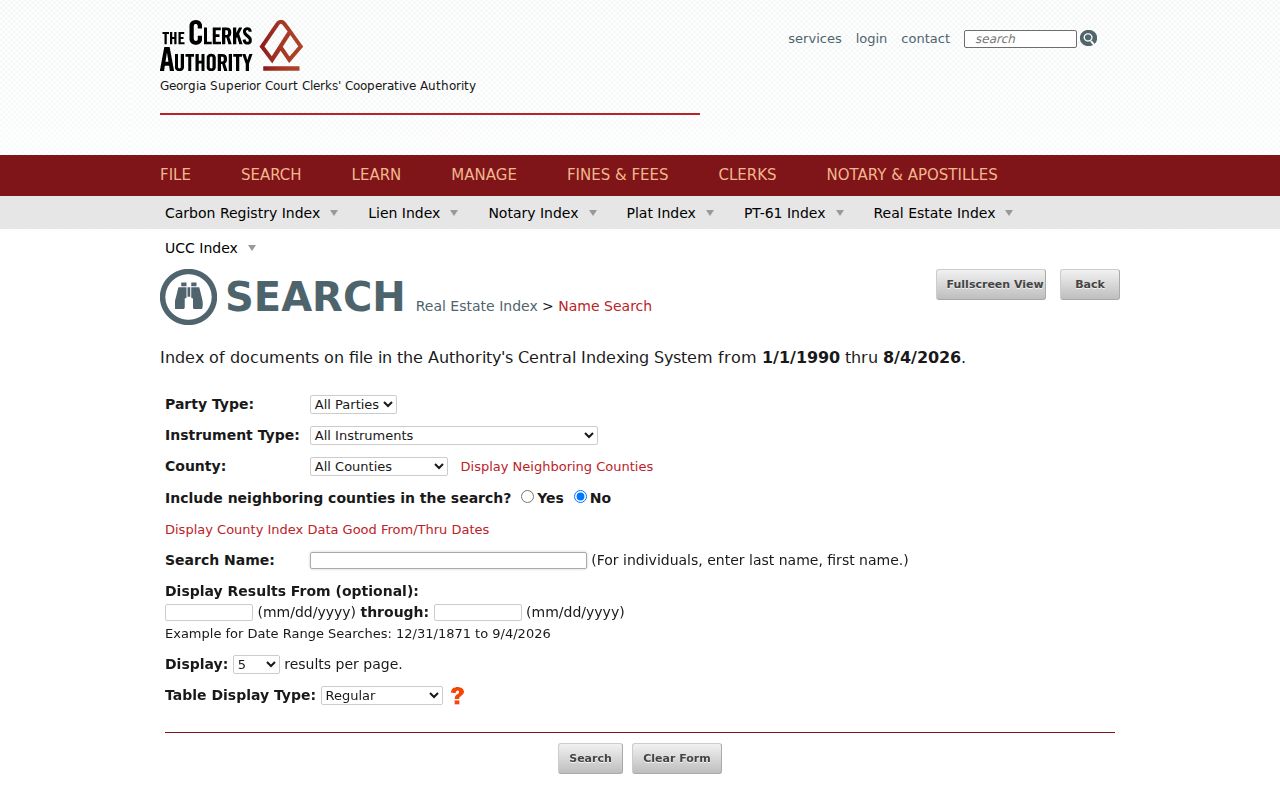
The available controls support a careful grantor-grantee walk of Lee County deed records. Pace the search and verify each link against the recorded instrument.
Link Lee County Plats and Deeds
Subdivision names, lots, land lots, districts, acreage, and cross-references all help. They separate one tract from another with the same label. The GSCCCA plat index adds name, land-lot, district, county, and date controls. A recorded plat can show a subdivision layout, rights-of-way, easements, and survey references. The deed should cite or describe exactly what land moved.
Never convert an old land lot into a modern street address. Do not do it without a map or deed crosswalk. Place labels in Lee County shifted over the years. Older material may point to Starkville, Wooten, or another historic community. Keep the original wording, and compare it against the present parcel. Then record whatever source joins the two.
Note: A plat depicts land division. A deed states the conveyance. Neither an assessor map nor a GIS viewer replaces those source records.
Reach Older Lee County Deeds
When the online chain stops, take the book and page to the Superior Court Clerk. Older deeds live there in bound volumes. The Georgia Archives County Records Microfilm Index works as a finding aid for early county holdings. Archives guidance sends researchers to tax digests, estate records, deeds, and county microfilm. The state property-research handbook lists the same companion sources.
Courthouse history adds a caution. Sources report fires at the Lee County courthouse in 1856 and 1872. Accounts differ on the first event's date or cause. Check survival series by series. A missing web hit does not prove a deed never existed. A historic narrative, however neat, cannot replace the recorded instrument itself.
The Lee County Library's digitized newspapers open another door. Its collections include the Ledger, the Journal, the Herald, and earlier material. Search owner names and places for sheriff sales, estate notices, subdivisions, and old roads. Then carry each lead back to deed books, plats, probate files, or tax records for proof.
Estate records can explain a break that first looks like a missing sale. Lee County Probate Court handles estates and wills. The Superior Court Clerk keeps the deed that later transfers the land. Search the decedent's exact name. Search the estate styling, the personal representative, heirs named in public filings, and the property description. A probate reference stays a lead until it is joined to the recorded conveyance. The same care applies to deeds naming a trust, an executor, or several grantees. Handle each capacity separately.
Old tax digests can supply the owner, acreage, description, and value. This helps in a year when the deed index is hard to follow. The Georgia Department of Community Affairs property-research guide points to tax, deed, estate, census, and archival records as complements. Use a digest to narrow the owner and place, then verify the transfer in a deed book. The person charged with tax is not proof of complete legal title.
Monitor Lee County Deed Filings
The statewide Filing Activity Notification System sends notices tied to a name or a property. Sign up once and it watches for you. FANS can flag a new transmission. But it makes no fraud finding and is not guaranteed complete or current. Lee County offers no separate alert product of its own.
After an alert lands, inspect the actual instrument. Compare its date, book and page, parties, legal description, consideration, and capacity against the parcel and tax record. Contact the Superior Court Clerk when the image or index is unclear. A corrective, estate, security, or other valid filing can look strange without context. Name searches often return more than conveyances. Security deeds, assignments, cancellations, and fi fas may sit beside them. Their presence does not mean ownership changed. Filter by instrument type, then read cross-references and recording dates. If the question is an unreleased lien or the legal effect of a filing, get help. Obtain the complete image and qualified title advice rather than trusting the index label.
Order a Lee County Deed Copy
Start with an online image when one exists and an uncertified view will do. GSCCCA's contact page lists regular access at $14.95 per month plus $0.50 per page. Premium access runs $29.95 per month plus $0.50 per page. Terms can change. A courthouse terminal or clerk copy may follow another process. Confirm the charge before ordering.
For a counter, phone, or mail request, give the county, full party names, instrument type, recording date, book and page or instrument number, and copy type. Ask what certification is available and how to pay. Administrative Open Records requests go to the county clerk. Routine deed-copy access stays with the Superior Court Clerk.
A useful request also names any related plat, prior deed, assignment, cancellation, easement, or PT-61 reference. These may be printed on the index or instrument. Ask for electronic delivery when the office offers it. If only part of a record can be released, request the non-exempt portion and the reason for any withholding. Georgia's Open Records framework generally requires a response within three business days. A response may set a later production date and cost estimate. It need not deliver the record at once.
Recorded, not guaranteed. Lee County deed records show what reached the recorder. They do not reveal every unrecorded interest or provide a legal title opinion.
For the parcel-to-record method, begin with the Lee County property lookup. Work from the parcel to the deed citation. Ownership disputes, unreleased liens, and unclear descriptions can arise. Closing choices call for qualified legal or title help, too. Keep the receipt with any copy obtained from the clerk. Keep the certification page and complete recording citation as well. Those details let a later reader return to the same official instrument. No one has to depend on a saved portal screen.