
Start a Lee County Property Search
There is no single giant database for Lee County. The route runs through the Tax Assessors Office, the Tax Commissioner, county GIS, and the Superior Court Clerk. Begin with the clue least likely to change over time. A parcel number is strongest. A street address helps when you know the site. Road labels and house numbers can shift. An owner name reaches both assessment and deed indexes. Trusts, estates, companies, initials, and spelling variants all call for care.
- Enter the address or owner in the official Lee qPublic/Schneider search. If the live screen is blocked, use the assessor office or its public counter.
- Save the parcel identifier, processed owner name, situs address, legal-description clues, value year, and map reference without changing their source labels.
- Check the same parcel in the Tax Commissioner's AssuranceGov search by tax year, name, bill, company, parcel, or address.
- Use the exact owner or entity in the GSCCCA Real Estate Index. Match the newest deed by recording date and legal description.
- Compare the parcel shape and jurisdiction in county GIS. Ask the custodian for a copy or a narrow record search when an online path fails.
This sequence keeps each record in its proper role. An assessment card is a practical starting point. It is never final title proof. A tax account confirms the billing record, not the deed. A GIS outline helps identify land, not settle a boundary dispute. The newest matching recorded instrument is the key ownership evidence, subject to professional title review.
Lee County Assessor Search Route
The Lee County Tax Assessors Office connects the public to the qPublic/Schneider parcel system. The office sits at 104 Leslie Highway, Suite B, in Leesburg. It is open weekdays from 8:00 a.m. to 5:00 p.m. The assessor maintains the digest and map information that anchors current parcel research. The Schneider interface sits behind a Cloudflare challenge for automated visitors. Its live field labels and sample parcel cards are best viewed directly in a browser.
The older Lee qPublic landing page remains a confirmed bridge into the parcel system. If the application will not load, call 229-759-6010 or visit the office in person. Ask for the parcel or map identifier tied to an exact situs address. Also ask which record year the screen displays. The county publishes no fixed update lag. A recent deed may post before the assessor's current processed owner field catches up.
The public assessor landing page shows the official handoff and office details at a glance.
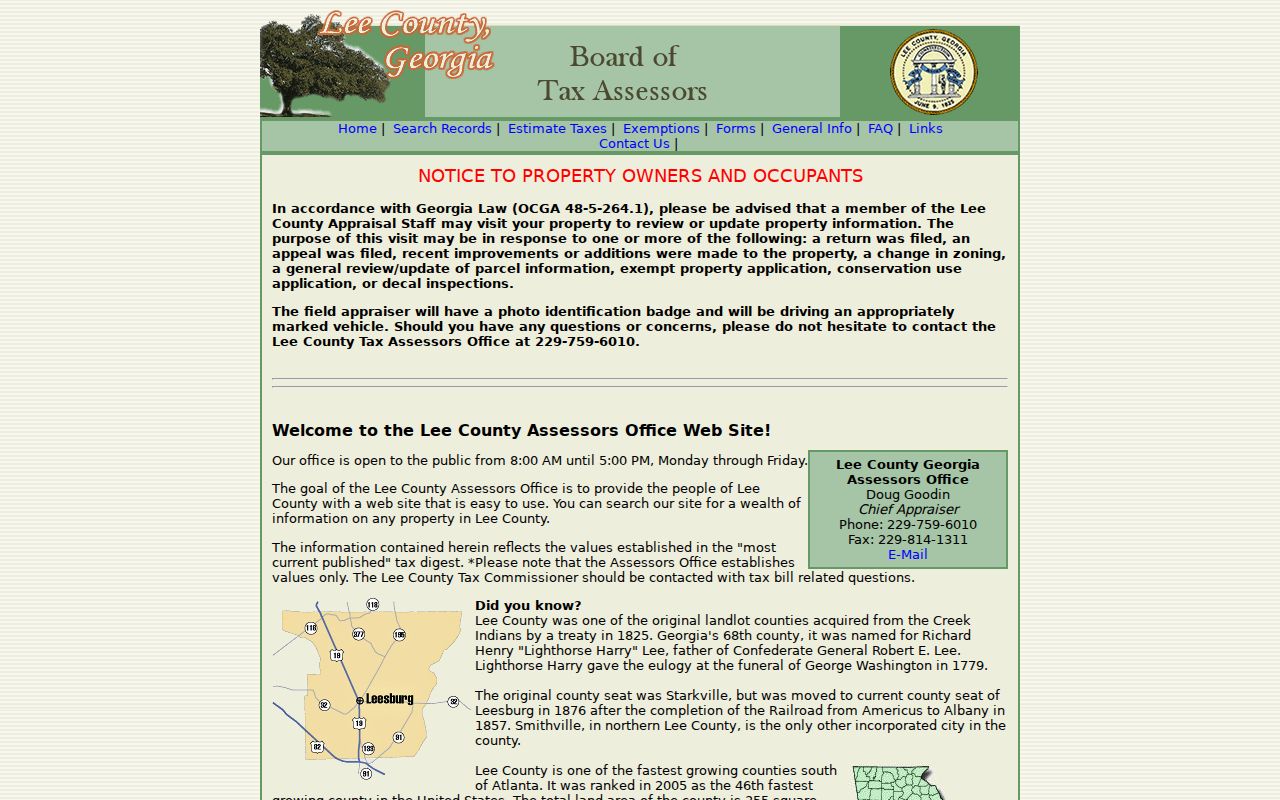
That official page confirms the assessor handoff and contact details. It does not by itself prove the search controls or a live parcel result.
Lee County Tax Search Fields
The Lee County tax property portal offers a second route when an assessor search stalls. It starts with a tax year. Then it offers search modes: Name, Bill Number, Company, Parcel, or Address. Name mode includes a last-name field, starts-with or contains matching, and an optional first name. The county publishes no documentation for the other mode-specific inputs. Their exact labels are best learned on the form itself.
| Portal field | Observed choice | Best use | Limit |
|---|---|---|---|
| Tax Year | Year selector | Fix the bill period | Not a current-title date |
| Name | Last name plus optional first | Find personal-owner accounts | Entities and shared names need care |
| Match | Starts with or contains | Handle initials or spelling | May return broad results |
| Bill, Company, Parcel, Address | Separate modes | Reach a known account | Exact subfields were not captured |
Every tax result belongs to a stated year. Keep that year attached when comparing the result with the assessor roll or a deed recorded later. A bill account can support a Lee County property search, but it should never be stretched into a claim about current title.
Search Lee County Deed Parties
Party lookups for deeds in Lee County run through the Clerk of Superior Court's recording system, with name searching handled by the GSCCCA Real Estate name search. The form is flexible. You can narrow results by party type, individual or business, and enter either a personal name or a company name. Additional filters cover county, instrument type, party role, date range, and how matches display. Set the county filter to Lee County. A good first move is to run the likely owner of record as grantee, then open the most recent matching instrument to see the deed details.
| Search field | Format | Use in the lookup |
|---|---|---|
| Party type | Individual or business | Match a person, trust, estate, or company |
| Name | Last/first or business name | Search exact forms and reasonable variants |
| County | Lee | Restrict statewide results |
| Party role | Grantor or grantee | Separate transfers out from transfers in |
| Instrument and dates | Type plus range | Narrow a known sale or filing period |
The county publishes no earliest complete online year for its deeds. GSCCCA itself warns that historical data and images vary by participating county. Need an older or missing deed? Contact Superior Court Clerk Sara Clark at 100 Leslie Highway, P.O. Box 49, Leesburg. You can also call 229-759-6018. The counter, the deed books, and the clerk-assisted copy route all remain part of the search.
Read a Lee County Property Result
A result earns trust only when each field keeps its source and its date. The assessor's current processed owner field may lag behind a new transfer. The tax portal is organized around a tax year and a bill. A deed index records parties and instruments. GIS supplies location context. These pieces can align, but they are not interchangeable.
| Processed owner | The name currently carried on the assessment record, not conclusive title. |
|---|---|
| Situs and mailing address | The land location versus the address used for notices; they may differ. |
| Parcel or map identifier | The stable key used to cross-check tax, map, planning, and request records. |
| Fair-market and assessed value | Year-labeled figures; Georgia generally assesses at 40 percent of fair-market value. |
| Legal description | Subdivision, lot, land lot, district, acreage, or deed-reference clues. |
| Recording reference | Instrument type, recording date, and book/page or instrument reference in the deed index. |
Never merge a mailing city with municipal limits. A Leesburg or Smithville postal address may sit outside the incorporated line. Check the county GIS, the planning jurisdiction field, a city digest where one exists, and any annexation ordinance or boundary map. A ZIP code is supporting evidence only.
Lee County Search Terms Defined
County systems lean on short labels that can conceal important differences. Keep these meanings in view as a parcel moves from one official source to another.
- Parcel number
- A county map or tax identifier for one assessment unit; it is also called an APN in general use.
- Situs address
- The physical location assigned to the property, distinct from the owner's mailing address.
- Owner of record
- The owner name carried by a stated source. On an assessor card, it means the assessor's processed field.
- Legal description
- The land description in a deed or plat, often using lots, blocks, land lots, districts, courses, or references.
- Book and page
- A clerk reference that points to a recorded instrument or plat in the official record series.
When Lee County Portals Fail
A paywall or login screen does not kill a Lee County property search. The assessor still takes questions by phone or in person. The Superior Court Clerk keeps the real-estate record and can explain how to get copies. GSCCCA runs the statewide index. Its subscription terms and image access can shift over time. Its published service options list regular access at $14.95 per month plus $0.50 per page. Premium access runs $29.95 per month plus the same per-page fee.
A county-held record can stay out of reach. In that case, a narrow Georgia Open Records Act request works well. Send it to County Clerk Kaitlyn Good at 102 Starksville Avenue North, Leesburg. Spell out the parcel, address, date span, record type, and the electronic format you want. Georgia law generally gives the county three business days to respond. It can instead state the expected production date, estimated cost, and any exemption. The statewide guide makes the first 15 minutes of search and retrieval free. Ordinary paper copies typically run $0.10 per page.
Older land research may need other sources. The Georgia Archives County Records Microfilm Index is one. Deed books, old tax digests, or the Lee County Library newspaper collection also help. Keep the older road, land-lot, subdivision, and owner labels intact. Forcing them into a modern address can erase the trail.
Match Lee County Place Names
Lee County dates to 1825. Its seat moved from Starkville to Leesburg after the railroad era. That history shapes any property search here. An older instrument may point to Starkville, Wooten, a land lot, or a road label that no longer exists. It may not match a current street address at all. Run names and places in parallel. The legal description and recording reference bridge the gap between eras.
County Planning and Zoning leans on the parcel ID too. Its address-request form quotes a 24 to 48 hour review. It routes address work through Planning, E911, and GIS. The subdivision application offers jurisdiction choices for Lee County, Leesburg, and Smithville. Those fields can help place a parcel. A proposed form or a mailing city never proves a boundary.
Note: Keep the historic label and the modern comparison apart. A map, deed, or recorded boundary source ties them together.
Watch New Lee County Filings
Georgia's Filing Activity Notification System, known as FANS, sends forward-looking notices. They can be tied to a name or property. Treat it as an alert tool, not a Lee County fraud finder. Coverage depends on what clerks transmit. Notices are not guaranteed to be complete or current. Lee County itself offers no separate filing-alert service. The FANS entry screen is where a monitored search begins.
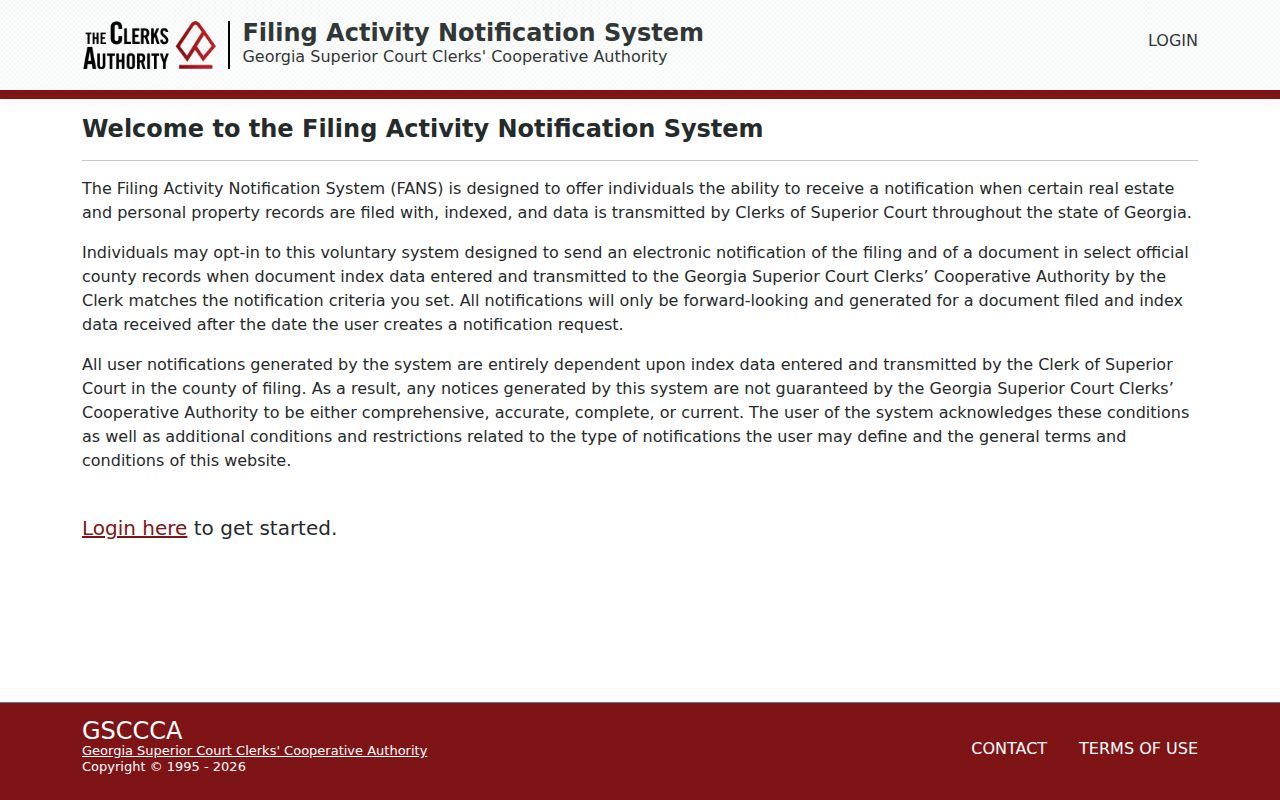
When an alert lands, save it and run a fresh GSCCCA search. Verify the exact party, instrument, recording date, book and page, image, legal description, consideration, and capacity. Then compare the parcel against assessor and tax records, and ask the Superior Court Clerk about any index detail that looks unclear.
Choose a Lee County Search Key
The right search key depends on the task and the record's age. An address pins down a present site. An owner name gathers records across holdings. A parcel identifier carries one assessment unit cleanly between systems. For a deed chain, the owner's exact legal name and the recorded legal description matter far more than any street label. No street label carries that weight.
| Search Key | Best For | Where It Works | Watch Out |
|---|---|---|---|
| Address | A known current site | Assessor, tax, GIS | Mailing city and old road names can mislead |
| Owner name | Holdings or transfer parties | Assessor, tax, GSCCCA | Trusts, estates, firms, initials, and common names |
| Parcel number | Cross-office matching | Assessor, tax, GIS, planning | Display formats may vary by source |
Not a title search. A Lee County property search finds public clues and recorded instruments. It cannot guarantee clear title, resolve every unrecorded interest, or replace a survey or professional title review.
For deeper instrument work, follow the Lee County deed records process. A parcel line may be the core question. The Lee County parcel map sources show how GIS and recorded plats differ.
A search that returns several likely parcels needs more than a name match. Weigh the situs, mailing address, parcel identifier, legal description, tax year, and recorded book and page against each other. Save the query terms and the date, especially when qPublic access drops out. That short audit trail lets the assessor or clerk reproduce the lookup. It also separates a portal access failure. It distinguishes that from a Lee County record that is genuinely missing.