
Read Lee County Property Tax Fields
Lee County property tax records live in two offices. The Tax Assessors Office keeps the digest, values, exemptions, and parcel data, while the Tax Commissioner keeps bills and collection records. Use the same parcel number and tax year across both.
| Field | What It Shows | Where |
|---|---|---|
| Fair-market value | January 1 value concept | Tax Assessors Office |
| Assessed value | Generally 40 percent of fair-market value | Tax Assessors Office |
| Exemptions | Approved taxable-value adjustments | Tax Assessors Office |
| Tax bill and status | Annual charge and collection account | Tax Commissioner |
| Millage | Rate applied to taxable assessment | Tax bill |
Georgia generally assesses property at 40 percent of fair-market value under O.C.G.A. §48-5-7. Exemptions and special classifications can shift the taxable assessment. Millage then produces the tax, and a deed or PT-61 sale figure is separate because it may reflect a non-market transfer.
Lee County Tax Office Roles
The Lee County Tax Assessors Office is at 104 Leslie Highway, Suite B, Leesburg, open weekdays from 8:00 a.m. to 5:00 p.m., telephone 229-759-6010. Its page links qPublic/Schneider. The live form was blocked during inspection, so its Lee-specific inputs remain unverified.
The Tax Commissioner at 100 Starksville Avenue North, telephone 229-759-6015, handles bills and collection. Ask the assessor about values and exemptions. Ask the commissioner about payment or delinquency.
The assessor page is captured here.
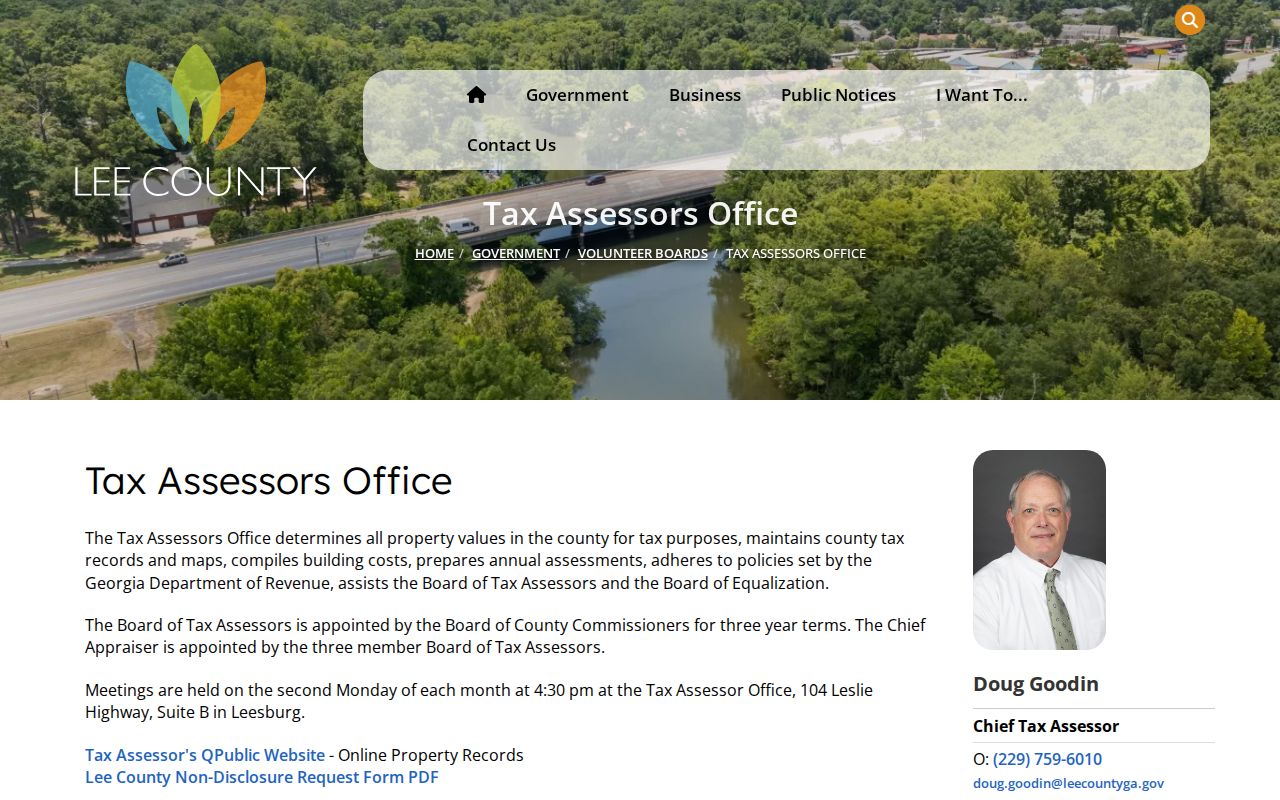
The capture confirms the office role, contact details, hours, and official parcel-search path.
Search Lee County Tax Accounts
The AssuranceGov portal starts with Tax Year and offers Name, Bill Number, Company, Parcel, and Address modes. Name mode supports starts-with or contains matching with a last name and an optional first name. Pick the mode that fits what you already know.
| Mode | Known input | Use |
|---|---|---|
| Tax Year | Year selector | Fix the bill period |
| Name | Last, optional first, match rule | Find a personal account |
| Bill or Company | Separate modes | Use a notice or entity |
| Parcel or Address | Separate modes | Start with land |
The official tax form appears in this image.
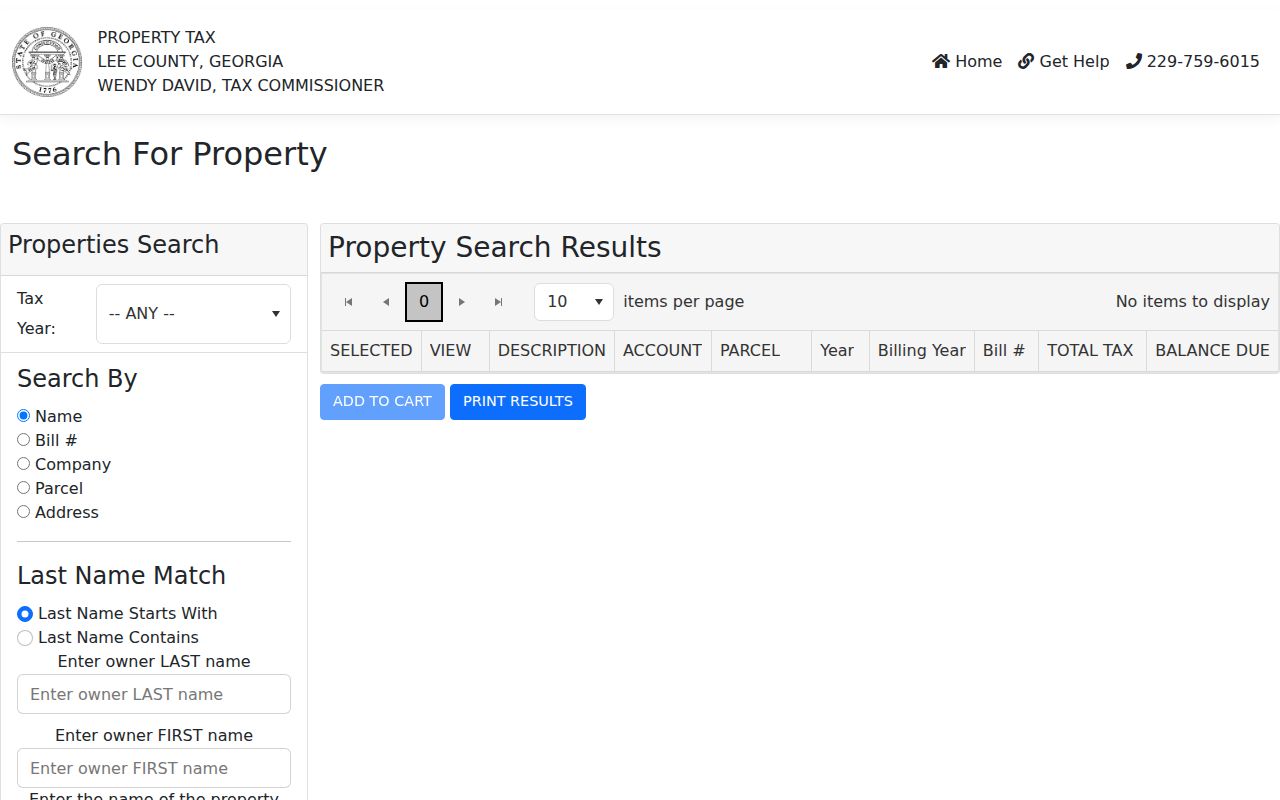
The page simply shows which lookup modes Lee County makes available, without displaying a live tax bill or every field on one.
Open a Lee County Tax Bill
Choose the tax year first. A later deed never rewrites an old account. One parcel can carry several annual bills, so search by parcel when you can and fall back to address or name, verifying the property location before reading the amount.
- Select Tax Year and choose parcel, address, name, company, or bill mode.
- Match the parcel and situs before reading the amount or status.
- Compare value, exemptions, and taxable assessment with the assessor source.
- Ask the Tax Commissioner about a payment, penalty, or delinquency item.
- Assessed value
- The statutory share of fair-market value before applicable adjustments.
- Millage
- A rate in mills applied to taxable assessment.
- Homestead exemption
- Approved relief tied to qualifying ownership and residence.
- Tax lien
- A claim from unpaid tax, distinct from a deed.
Taxes are generally due December 20, and delinquent sums can accrue interest and penalties under O.C.G.A. §§48-2-40 and 48-2-44. Confirm the live bill before relying on a copied date.
Lee County Tax Calendar
Owners file returns between January 1 and April 1. A first-time homeowner claiming homestead should bring a warranty deed, and the driver's license should show the current Lee County physical address. A post-office box will not do. Existing exemptions generally renew until ownership, residence, or qualification changes.
| January 1 | Annual fair-market value date. |
|---|---|
| January 1 to April 1 | Return and exemption filing period. |
| Assessment notice | Starts the 45-day appeal period. |
| December 20 | General property tax due date. |
The dated source is the 2026 taxpayer brochure. It and current forms carry exemption amounts plus agricultural, conservation-use, forest-land, historic, and brownfield rules.
Lee County's 2025 Tax Review
A county notice reported an error in the 2025 rollback calculation and about $1.5 million in overpayment, followed by review and refund context. That dated event does not support a private recalculation. Keep the year, parcel, and bill number ready. Ask if a correction affects the account. A separate notice explained HB 581 homestead value protection, county action, and 2025 millage. One year's summary rarely fits another. Read each year's notice, digest, rate, and exemption facts together. Note: A tax correction changes the affected fiscal record; it does not alter a deed or establish present title.
Reconcile Lee County Tax Records
When sources disagree, compare parcel, tax year, value type, and processing date. A fair-market figure is not the 40-percent assessed figure. Net assessment is not deed consideration. A bill may still name the taxpayer tied to that year even after a newer deed is recorded. Keep each source labeled and explain the time gap. For a sale, check the deed or PT-61. Never assume tax value equals price. Estate, related-party, partial-interest, nominal, and distressed transfers may not reflect the open market. For land inside a city, check whether a municipal tax record also exists. The Leesburg 2025 digest lists bill number, owner, property location, description, map reference, class, 100-percent value, 40-percent value, exemptions, net assessment, and city tax. It is a snapshot, not a live parcel card. It can bridge Magnolia Subdivision or Academy Street entries to county assessment, GIS, and deed sources. It does not prove the owner stayed the same. Smithville publishes no multi-year value series, so county records and direct city inquiry are safer there.
Request Lee County Tax Records
Start with a phone call or a counter visit. Give the staff the parcel number, the situs address, the owner name as shown, the tax year, and the bill number if known. Say what you need. The assessor handles digest entries, property cards, assessment notices, exemption records, and appeal material. The Tax Commissioner handles bills, account history, payment entries, penalty detail, and delinquency records. Know which office owns which question.
For records beyond routine service, file a narrow Georgia Open Records Act request. State the date range and format. The county generally must respond within three business days. That response can explain the production date, the estimated cost, and any claimed exemption. It is not always the records themselves. State guidance sets the first 15 minutes of search and retrieval free, with ordinary copies commonly at $0.10 per page and other media charged at actual cost.
Audit a Lee County Tax Figure
Start with the year and the label beside the number. Labels matter. Fair-market value is the assessor's January 1 concept of what the property is worth. Assessed value is generally 40 percent of that figure. Exemptions and special classifications can change the taxable assessment. The millage rate then produces the bill. Write the steps as a chain instead of comparing unlabeled totals.
A deed's consideration, its PT-61 amount, and the annual tax value answer different questions. A transfer can be nominal, between relatives, through an estate, for a partial interest, or part of a distressed deal, which makes consideration a poor market comparison. If the sale feeds an appeal, keep the instrument type, transfer date, party capacity, and property interest with the amount.
Improvement facts need dates too. A permit application describes proposed work only, not proof that it was issued, inspected, or completed. For an improvement dispute, request the application, the issued permit, the inspection history, corrections, the final inspection, the certificate of occupancy, and the fee record. Check the assessor's value year. The property characteristics should match the same date.
Acreage and class disputes call for the recorded deed or plat, and a licensed survey when needed. GIS helps with orientation. A screen line does not amend the legal description. A zoning color is not an assessor class either, so ask the relevant office for the source and date behind each field that shapes the Lee County property tax record.
Appeal a Lee County Assessment
Lee County gives an owner 45 days from the assessment notice to appeal. Follow the route printed on the notice. Name the parcel, the year, the disputed field, and the correction you want. Strong evidence helps. Bring the property card, date-linked photos, and deed context. Add a survey or plat for land facts, plus comparable records with similar traits.
The assessor reviews value and exemption issues. The Tax Commissioner cannot change assessed value just because a bill is high. A payment dispute will not reopen the assessment. Keep the two routes separate and obtain proof of a timely filing.
Appeal window. Lee County assessment appeals must be filed within 45 days of the notice. The notice date, not the later bill, starts that period.
For value fields beyond billing, see Lee County property value. Start with the Lee County property search. Save everything. Keep the filed appeal, the delivery proof, the assessment notice, and every office response. Record any later hearing date beside the tax year. A portal screenshot alone may not preserve the notice date, the evidence submitted, or the final disposition.
After a decision, check the revised field. Compare it with the assessor record and bill. A value change may not appear in every system at once. Ask each office which source is controlling for its own task, and whether a corrected notice, digest entry, or bill will follow.