
Identify Who Owns a Lee County Property
Lee County ownership research works best as a short evidence chain. The Tax Assessor's Office supplies the current processed owner clue, while the Clerk of Superior Court supplies the recorded conveyance itself. Keep the parcel number handy. Also keep the legal description, source date, and exact owner spelling at every step.
- Search the address in the Lee County qPublic landing page and save the map or parcel identifier.
- Compare the owner or taxpayer name, situs, and legal description with the tax account.
- Search that name as grantee in the GSCCCA Real Estate Index, limited to Lee County.
- Inspect the newest matching deed and verify its land lot, district, subdivision, lot, acreage, or prior deed reference.
What if the assessor and the deed disagree? Keep both dates. The assessor may lag behind a recent recording, or the deed could involve an estate, a trust, a corrective instrument, or a partial interest.
Match Lee County Owner Clues to One Parcel
An owner or taxpayer name means little without its parcel. Pin it to the situs, mailing address, map or account number, legal description, value year, and any book and page reference. A mailing address is not the land. It may belong to a business, an attorney, or an owner living outside the county.
- Owner of record
- The person or entity in the current processed assessment record.
- Situs
- The physical property location used to find the parcel.
- Grantee
- The party receiving an interest in the recorded deed.
- Title
- The legal ownership interest, which a public lookup alone cannot certify.
Lee County parcels use formats like 029C 001. City-style LSE identifiers also appear, and the county publishes no complete prefix guide, so copy every space and punctuation mark exactly.
When Lee County's Assessor Search Stops Short
Lee County names Schneider qPublic as its parcel-search destination. A Cloudflare challenge often blocks the live Lee interface. Don't assume the search fields or invent a parcel card. The assessor's office sits at 104 Leslie Highway, Suite B, in Leesburg. Staff answer the phone at 229-759-6010 on weekdays from 8:00 a.m. to 5:00 p.m.
The AssuranceGov tax search offers another route. It covers Tax Year plus searches by Name, Bill Number, Company, Parcel, and Address. Name mode supports starts-with or contains matching. An optional first name narrows results.
The official Lee County qPublic landing page is the assessor's entry point.
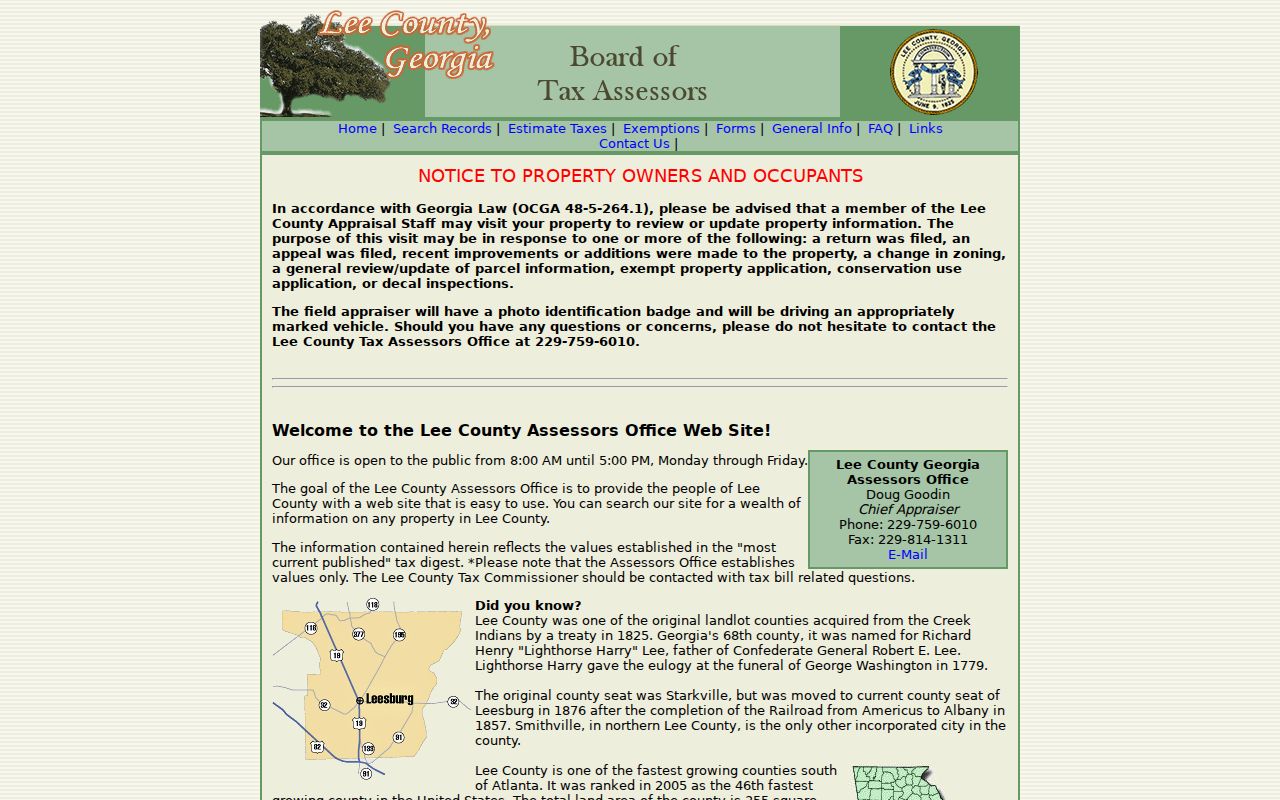
The named route is official, not a substitute. A live lookup still shows the parcel and its source date. Note: An official portal link alone does not guarantee that every result field or current owner will appear in a live search.
Where Lee County Property Ownership Appears
No single source answers who owns a property. The strongest answer joins the current assessment clue to the most recent deed describing the same Lee County land.
| Ownership source | What it contributes | How to reach it |
|---|---|---|
| Tax Assessors Office | Processed owner or taxpayer, situs, parcel and assessment context | qPublic or the Leesburg office |
| Superior Court Clerk | Recorded grantee, document type, date, book/page and legal description | GSCCCA, courthouse terminal, mail or office copy |
| Tax Commissioner | Tax account and tax-year link to the parcel | AssuranceGov or the tax office |
| County GIS | Map orientation and a visual parcel cross-check | Official ArcGIS map or GIS office |
None of these sources proves who occupies a site. This method serves land records, purchase diligence, estate work, and boundary questions in Lee County, not resident identification.
Trace a Lee County Owner Name to the Deed
Deeds in Lee County are recorded by the Clerk of Superior Court rather than the administrative County Clerk. The office handles warranty deeds, quitclaim deeds, security deeds, easements, rights-of-way, plats, and transfer-tax documents. The GSCCCA name search lets you narrow by party type, instrument type, and county, and it shows dates and name fields you can adjust. To confirm a recent purchase, limit the county and choose the grantee or buyer role.
Index details and the recorded image give you the exact parties and their capacity, the recording date, book and page, the instrument type, the legal description, and references to earlier deeds. Keep in mind that a security deed documents financing. It is not a fee-simple transfer of ownership. The statewide index covers every county going back to 1999, though Lee County does not publish its own earliest complete online year.
If the online record falls short, contact the Clerk at 100 Leslie Highway, P.O. Box 49, Leesburg, or call 229-759-6018. Researching at a courthouse terminal or ordering copies through the Clerk may cost different amounts than the GSCCCA subscription and image terms.
Decode Lee County LLC, Trust, and Estate Owners
An owner name may hide an entity, whether an LLC, corporation, trust, estate, bank, or several co-owners. Preserve the exact entity suffix. Keep any trustee, executor, administrator, attorney-in-fact, or survivorship language too. Then search the Georgia Corporations Division by exact business name and variants. Its modes include Starts With, Contains, and Exact Match.
Corporate registration is not title. It can help reconcile a name or control number, but for an estate a probate appointment or will supplies context, while the later recorded conveyance shows what reached the deed record. An entity's mailing address is rarely the property's situs.
Use Lee County Filing Alerts as a Prompt
Georgia's Filing Activity Notification System watches new filings tied to a name or property. Lee County publishes no separate county-branded fraud alert. FANS relies on Clerk transmissions, so a notice may be incomplete or delayed, and it never proves fraud occurred.
Save the alert. Then search the exact party and instrument in GSCCCA. Compare the legal description with the parcel, and ask the Superior Court Clerk about any unclear image. The FANS enrollment page details the service.
Note: A FANS notice starts verification, but it neither establishes ownership nor repairs a break in the historical deed chain.
Know the Limits of a Lee County Owner Lookup
A Lee County parcel owner field is not a title opinion. An index hit is not an unbroken chain either. Spelling differences, estate or trust transfers, tract splits, corporate name changes, unrecorded instruments, and missing images can all open gaps in the record. Timing matters too. A new deed may post before the assessor processes it. When a formal title conclusion is required, use a Georgia real-estate attorney or title professional.
Owner names are not title proof. Ownership may sit in an LLC or trust, and Lee County records must be used only for lawful diligence, never to stalk, harass, or harm anyone.
Georgia and Lee County do offer targeted confidentiality measures. VoteSafe is one, and the assessor runs a non-disclosure process for qualifying law-enforcement officers. Neither program creates a general right to suppress ordinary parcel records. Still, protected address details should not be republished.
When a public portal comes up short, pick the custodian by record type. The Tax Assessors Office holds the processed assessment and map record. The Tax Commissioner handles the tax account and bill year. The Superior Court Clerk keeps deeds, plats, liens, and certified copies. The administrative County Clerk routes requests for existing county records that lack a public search interface. One broad question sent to every office can blur the line. It mixes an assessed name with recorded ownership. Match the request to the office that actually owns the record.
A narrow request works best. State the address, parcel or map number, owner or entity if known, record type, and date range. For an assessment request, ask for the owner or taxpayer field, situs, legal description, classification, fair-market value, and assessed value. Also request exemptions, the map reference, and any releasable digest or update date. Georgia Open Records guidance gives an agency three business days to respond with records, a production schedule and estimate, or an exemption. It does not require the office to create a title analysis.
Say exactly what you checked in the final ownership note. "Assessor's current processed owner field" is accurate when only the roll was reviewed. "Recorded grantee" is accurate after the deed itself was inspected. If the deed image, legal description, or recording date could not be confirmed, state that gap plainly. A transparent answer names its source and date. A name match alone is never a claim of title.
For land held by several grantees, keep every name and the capacity printed in the deed. Do not shrink a trust to its trustee. Do not reduce an estate to one heir. Do not collapse a company to its registered agent. The Georgia Corporations search can clarify an entity's exact name and control number. But corporate registration is not the parcel conveyance. The recorded instrument stays the property-specific source. A PT-61 result may supply a buyer, seller, or consideration clue. Yet it must be matched to the deed before it supports an ownership statement.