
Trace Back Lee County Former Owners
Treat the chain as a timeline of transfers. Don't think of it as a loose list of similar names. Every entry must describe the same land. Tie each row to a legal description or a recorded cross-reference. That keeps the Lee County parcel constant while the owners change. The dates in a worked example are illustrative. Insert only dates taken from the actual instruments.
| Transfer date | Grantor to grantee | Instrument | Record locator |
|---|---|---|---|
| Newest verified date | Prior owner to current grantee | Warranty, quitclaim, estate, corrective, or other deed | Book/page or instrument number |
| Earlier verified date | Earlier grantee to later grantor | Matching acquisition deed | Book/page plus prior deed reference |
| Parcel split date | Parent tract owner to lot grantee | Deed with plat reference | Plat book/page and deed citation |
| Archival stopping date | Last verified earlier parties | Older deed-book entry | Courthouse or microfilm locator |
Not every recorded instrument transfers ownership. Security deeds, assignments, and satisfactions track financing interests. Quitclaim and warranty deeds also carry different legal effects, so preserve the instrument label exactly as the Lee County deed index records it.
Fix the Lee County Starting Parcel
Pin down the parcel first. Collect the address, map or parcel number, subdivision and lot, land lot and district, acreage, and current assessed owner, then compare the qPublic entry point, the GIS map, and the tax account before opening the deed index. A mismatch at the start becomes a false chain.
Street addresses make weak historical keys. Lee County's own Address Request Form shows why. Address assignment sits apart from the deed record. Older tracts may predate the road name or sit inside a larger parent parcel, so legal descriptions and plat references bridge those changes.
- Grantor
- The party conveying an interest.
- Grantee
- The party receiving that interest.
- Reverse index
- A way to search by the conveying party rather than the recipient.
- Chain of title
- The ordered sequence of instruments affecting the same land.
- Quitclaim versus warranty
- Different deed forms whose actual legal effect should not be inferred from the name alone.
Go Back Through the Lee County Deed Chain
The GSCCCA Real Estate Index is the statewide online path. Its name form filters by party type, instrument type, county, and date, with fields for names and display options. Stay in Lee County unless a documented clue points elsewhere.
- Find the current acquisition by searching the assessed owner as grantee or buyer.
- Read the grantor, capacity, recording date, legal description, and prior deed reference.
- Search that grantor as an earlier grantee, then match the same tract before accepting the result.
- Repeat until the desired date or an online gap, recording gap, estate transfer, or parcel split requires another source.
Names rarely match perfectly across decades. Try initials, married names, exact entity suffixes, trustee language, and spelling variants as you move back through Lee County deed records. A name match is only a candidate. The GSCCCA real-estate name search exposes the filters that carry you from one former owner to the prior conveyance.
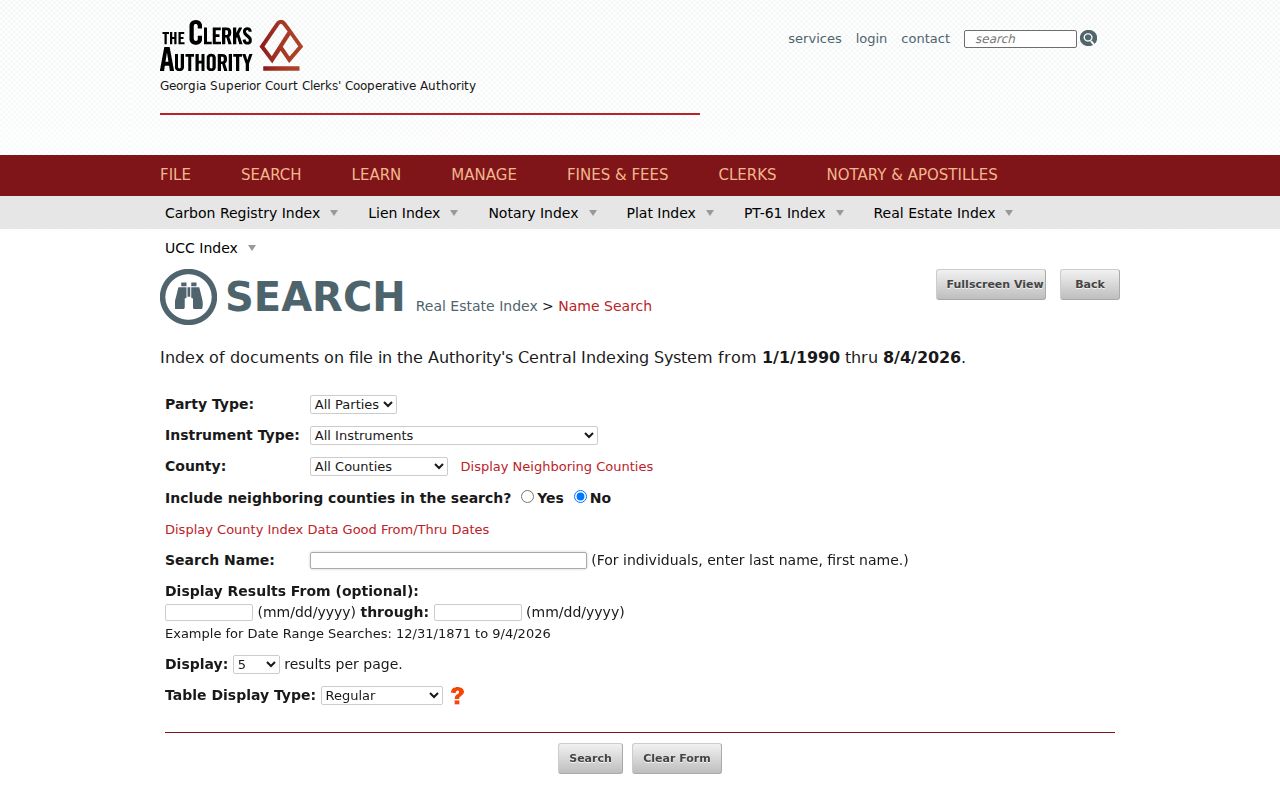
Use the results as an index to matching instruments. Open the deed itself and read the legal description before adding any link to the Lee County ownership chain.
Know Lee County's Online Deed Depth
GSCCCA dates its all-county real-estate index to January 1, 1999. The form's central range begins January 1, 1990. Historical data from 1993 through 1998 are being added, per the same source. None of this sets a Lee County cutoff.
Online cutoff. Do not claim that Lee County prior owners disappear at one fixed year. Record the last verified deed and continue through the Clerk, deed books, microfilm, or archives.
Web subscriptions run $14.95 monthly for regular access and $29.95 monthly for premium, plus $0.50 per page. Terms can change. Courthouse terminals and Clerk copy requests price differently.
Reconstruct Older Lee County Ownership Records
Older chains of title take more digging. The Lee County Clerk of Superior Court, at 100 Leslie Highway in Leesburg, can be reached at 229-759-6018, and the courthouse offers a terminal plus deed books for hands-on work with older parcels. From there, the Georgia Archives County Records Microfilm Index and FamilySearch guidance help you locate surviving deed, tax, estate, and court series tied to Lee County property records.
The archival trail has gaps worth knowing. Lee County dates to 1825, and the seat eventually moved from Starkville toward Leesburg. A Starkville courthouse fire, dated by sources as either 1856 or 1858, remains genuinely disputed. That uncertainty explains why anyone tracing a former owner of record must confirm which deed records actually survived instead of assuming an unbroken run.
Note: An old tax digest can name an assessed owner and describe the parcel, but it does not replace the conveyance recorded in a deed book.
Bridge Lee County Estate and Parcel-Split Gaps
A clean grantor-to-grantee line can still break. Land often moved through an estate, trust, survivorship instrument, corporate change, or a larger parent tract. For an estate, turn to Probate Court files. Identify the representative and the context, then return to the recorded executor, administrator, heirs', or distribution deed.
For a parcel split, compare acreage, lot, block, subdivision plat, and land lot or district. Follow the parent parcel into the earlier deed. Do not force today's number backward. Newspapers can surface probate notices, sheriff sales, and subdivision announcements, but each clue needs confirmation in the deed, tax book, court file, or plat.
Mark Where Lee County Ownership History Ends
End the chain at the last verified evidence. Never guess an original owner. Record the names, date, book and page, legal description, source, and the reason the next link could not be confirmed. The Lee County Library's digitized newspaper runs and the 1901 county history supply search leads, while Georgia Archives materials identify older record series.
Research boundary. A reconstructed public-record chain is not a title opinion. Missing instruments, probate issues, liens, survey conflicts, or unindexed documents may remain.
Former-owner records have legitimate uses. House history, estate work, purchase diligence, and documented land research all qualify. They are not for watching people, and old or current personal details must never be used to track, target, or harass anyone.
The library's digital archive runs deep. The Lee County Ledger spans 1978 through 2015. The Lee County Journal covers 1904 through 1974, the Herald 1994 through 2000, and a digitized 1901 history sits alongside shorter newspaper runs. Search both people and places, since OCR and historical spelling vary, and probate notices, sheriff sales, subdivision announcements, obituaries, and former road names can each suggest the next deed-book search.
A newspaper hit is just a lead. Confirm the transfer in the recorded instrument, tax book, plat, probate file, or court record, and keep the execution date separate from the recording date. Preserve any estate or trustee capacity too.
Carry Lee County Prior Owners into the Archives
Make an archival handoff sheet first. Copy the last verified book and page, recording date, grantor, grantee, instrument type, land lot and district, subdivision or acreage, and every prior-deed reference. Note why the next link failed. The reason could be an index gap, missing image, changed surname, estate transfer, or parent-tract description. That sheet keeps the courthouse and microfilm search anchored to real evidence.
At the Clerk's office, ask for the deed book named in the last citation. Check both direct and reverse indexes when available. Georgia Archives county cards and FamilySearch guidance can identify older microfilmed deed, tax, estate, and court series. Old tax books may narrow the year an assessed name changed, but the entry is only a clue. Probate files can explain the representative or heirs. The later recorded deed shows the actual land conveyance.
Lee County history adds wrinkles: the county seat moved from Starkville toward Leesburg, and the courthouse-fire date is disputed as 1856 or 1858. Source labels matter. Record whether each fact came from a county history, newspaper, archive finding aid, tax book, or deed. Never convert an old road, community name, or land lot into a modern address without a map or recorded cross-reference. The older chain stays strongest when every clue points back to an actual instrument.
Keep any access gap separate from the chain itself. A book or image may simply be unreachable online. Note that plainly. An unavailable image does not prove that no conveyance was recorded.